Why RF Language Distribution Still Has Its Role
How decades old technology remains one of the most practical ways to deliver simultaneous interpretation at scale.
By Emma Mas-Jones, VP of Global Events at Conference Rental
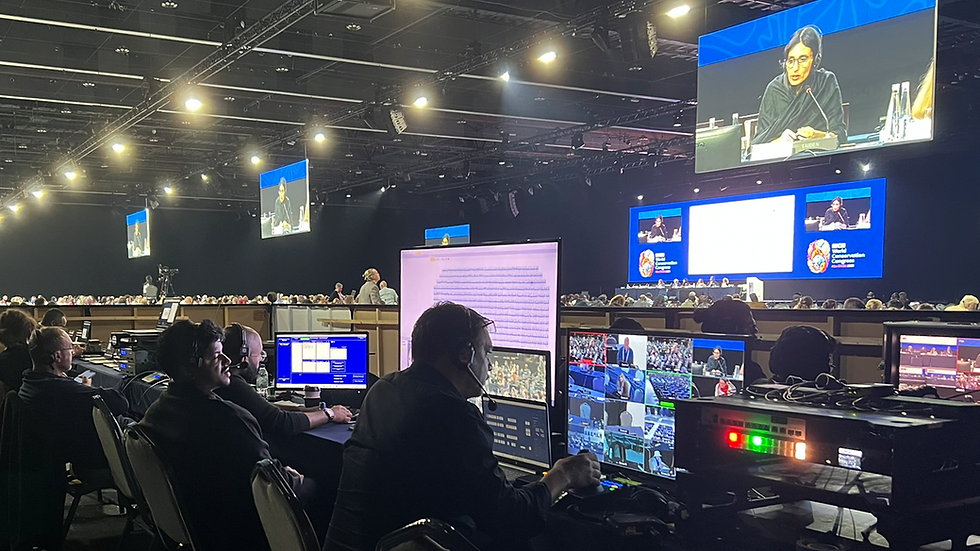
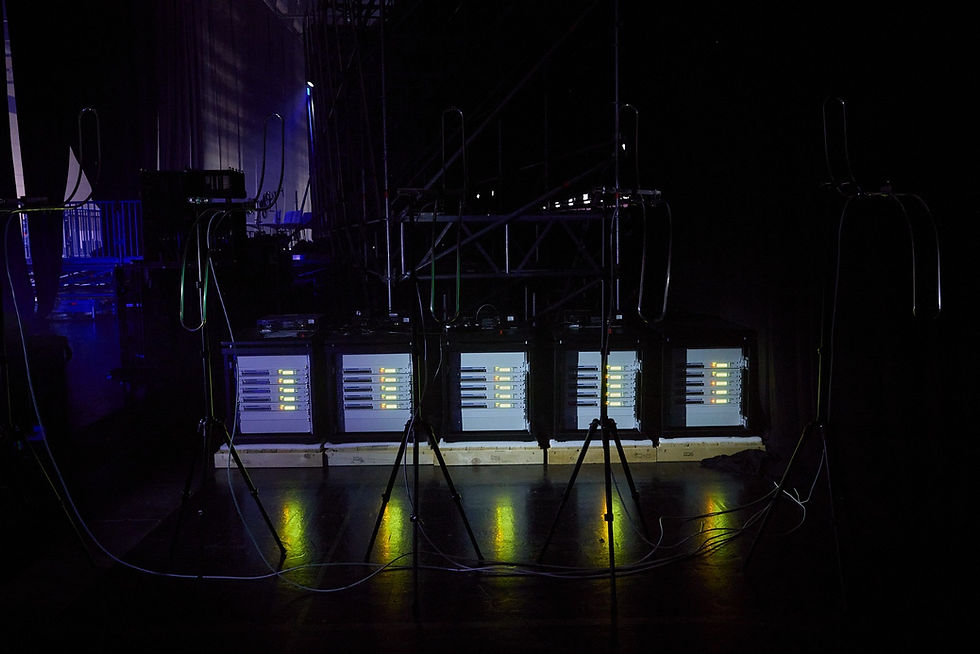
Racks of FM transmitters, paired with purpose designed broadcast antennas and the FM receivers delegates wear on a lanyard, sit in Conference Rental's warehouses between shows. They are well traveled. In just over a quarter this year, this solution has been implemented across three different continents and three of the largest multilingual events on the calendar.
Different countries, different audiences, the same solution. Understanding why RF language distribution still has a place in multilingual event delivery, even in an era of apps and Bring Your Own Device, matters more than ever for anyone planning an international event.

Technology that refused to be retired
FM language distribution has post-war roots. The basic principle, broadcasting a narrow audio band over a dedicated frequency so that any matched receiver in range can tune in, has been carrying simultaneous interpretation since the original UN sessions of the late 1940s. What has changed is miniaturization, battery life, antenna design, and the sophistication of the transmitter itself. What has not changed is the physics.
A properly configured FM broadcast is one-to-many. It does not negotiate a handshake with each device. It does not depend on a venue server. It is not throttled when an access point reaches its concurrent connection limit. It simply transmits, and any receiver in range picks it up. That single property is why FM remains one of the best solutions for large-scale multilingual events.
Where BYOD Can Struggle
Bring Your Own Device (BYOD) solutions deliver multilingual audio over the venue Wi-Fi through an app or web browser. It is a superb modern option, cost-effective to scale, easy to deploy internationally, and for many delegates, the preferred way to listen. But BYOD may introduce problems without the proper network infrastructure.
Wi-Fi blind spots. Older convention centers, ballrooms, and exhibition halls, may produce Wi-Fi dead spots. A delegate in one of those areas can lose connectivity and disconnect from the interpretation mid-sentence.
Congestion at scale. Enterprise Wi-Fi is rated on peak concurrent connections, not on announced venue capacity. Drop 5,000 delegates into a room, each on a phone, add staff, press, and Wi-Fi based production comms competing for spectrum, and access points saturate. The symptom is not a clean failure; it is degraded audio that lags and stutters.
App and device friction. First time users stumble on the download, the login, and the language selection. Delegates with older devices may experience issues connecting to Wi-Fi, the app or hearing the audio due to newer technologies being incompatible with older devices. Mobile device battery life also plays a role in whether the delegate has access to the interpretation for the entire meeting.
No graceful failover. If Wi-Fi fails during the event, there's no easy solutions to get back online without disruption to the meeting.
Why regulators still matter
FM broadcast is not a free-for-all. Every country has its own rules for which frequencies may be used, at what transmit power, and by whom. For a major leadership summit in Vienna, Conference Rental secured 25 FM licenses for the week and deployed transmitters calibrated to sit exactly inside the Austrian regulatory envelope while still reaching every delegate cleanly across several halls. Where licensed spectrum is scarce or turnaround is short, we broadcast in the license-free bands permitted across multiple countries instead.
The real answer is hybrid
The case for FM is not a case against BYOD. It is a case for designing language delivery the way any mission-critical system is designed: with redundancy. At this major leadership summit in Vienna, the main hall ran FM and BYOD simultaneously. Delegates were able to choose. FM carried the majority of listeners, including every delegate in the back of a hall where Wi-Fi was uncertain. BYOD absorbed the walk-in demand without pressure on receiver distribution. Neither solution was carrying the whole show on its own.
Plan for the worst case Wi-Fi scenario in the worst case seat, then use BYOD to make the good seats even better.
The takeaway
RF is not a legacy medium being phased out. It still has its place in many multilingual events where reliability and scale matter, or venue Wi-Fi isn't sufficient. Paired with BYOD and a modern RSI platform, it is what allows us to modernize multilingual events while still providing the stability our clients depend on.